
Reviewed · WALKING TOURS
TIRANA Walking Tour: Discover the ever-changing capital city
Tirana’s story is easiest to grasp on foot, and this tour puts you right in the middle of it. You move from Skanderbeg Square, with its Ottoman mosque and Communist-era museum, toward the old bridge, Blloku, and today’s café culture. In a few hours, the city’s sharp changes begin to make sense.
I like the included National Historical Museum ticket, since it gives the tour a solid historical base. I also like the small group limit of 15, along with guides such as Gloria and Ilir, who tailor the walk, explain modern Albania, and keep the pace human.
The main consideration is that Tirana is still changing fast. Construction can affect views and the National Gallery of Art is currently closed for expansion. You should also expect a fair amount of walking in warm weather, with no hotel pickup or food included.
Key points to know before you book
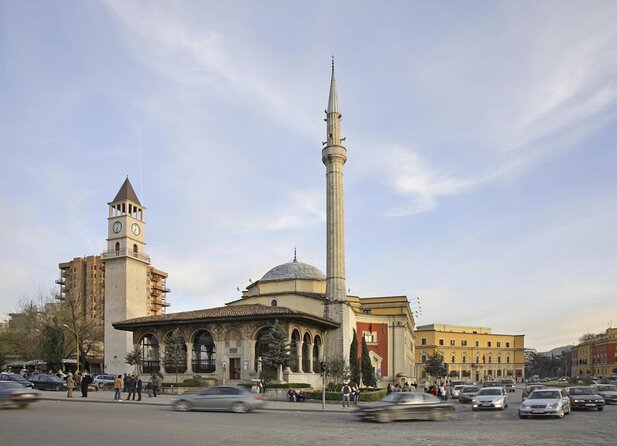
- Skanderbeg Square brings several eras together: You see the National Historical Museum, Opera House, Clock Tower, and Et’hem Bey Mosque in one opening sweep.
- The Clock Tower climb takes 90 steps: The small viewing platform gives you a useful look over central Tirana, though nearby construction affects the view.
- The National Historical Museum ticket is included: Its displays help explain Albania’s long, often difficult past, but opening status can change.
- The route reaches both old and new Tirana: Ottoman bridges and mosques lead toward the polished cafés, bars, and boutiques of Blloku.
- Guiding is the main strength: Gloria and Ilir have been praised for clear English, strong storytelling, and adjusting the walk to individual interests.
- The walk is compact but active: The tour lasts about 3 to 4 hours, begins at 9:30 am, and returns to the Tirana International Hotel.
Why this walk is a useful first look at Tirana
Tirana can seem scattered at first. One block has a mosque and a clock tower. The next has Communist monuments, new towers, outdoor cafés, and construction fencing. This walk gives those pieces a sequence.
You begin at the Tirana International Hotel on Skanderbeg Square at 9:30 am. From there, the guide sets out on foot and explains how the capital has changed through Ottoman rule, the Communist period, and the post-1990 years.
The format works best if you want context instead of a quick checklist of buildings. You will hear about Albania’s national hero, religious life, the dictatorship of Enver Hoxha, and the city’s current social scene. Guides Gloria and Ilir have been singled out for making the past understandable without turning the walk into a lecture.
The group can include up to 15 people, though the actual size may be smaller. When only a few people join, the walk can feel almost private, and the guide has more room to follow your questions. That is especially useful in Tirana, where the most interesting details are often political or cultural rather than purely architectural.
Other guided walks in Tirana:
- Walking Tour of Tirana
★ 5.0 · 646 reviews - Local food experience & walking tour of Tirana
★ 5.0 · 192 reviews - Tour a Piedi di Tirana
★ 5.0 · 174 reviews
Skanderbeg Square and the buildings around it
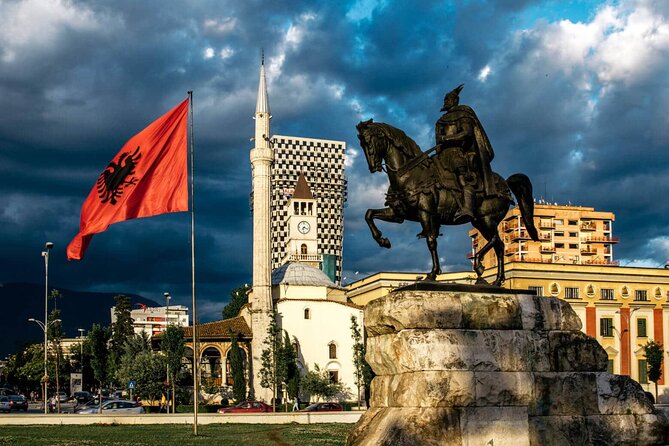
The tour begins at Tirana’s central square, named for Albania’s medieval national hero, Skanderbeg. This is the right place to start because the surrounding buildings show how many layers of the capital occupy the same space.
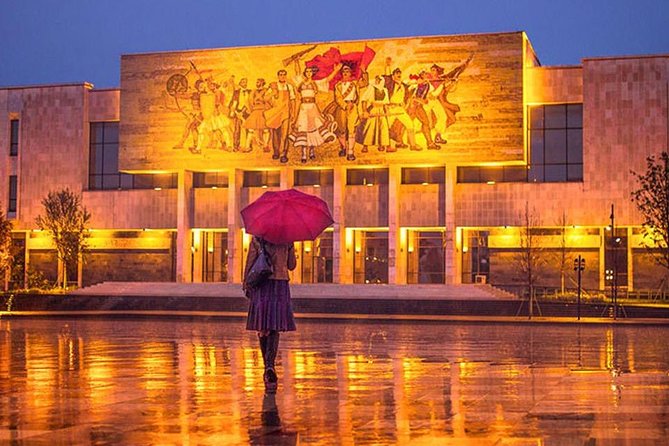
The National Historical Museum is the most obvious landmark. Its large mosaic-covered façade presents an official version of Albanian identity, while the collections inside take you through the country’s past. The included ticket adds real value to the tour, since you are not left to guess why Albania’s history can feel so complicated.
The square also faces the National Opera House, the old Clock Tower, and Et’hem Bey Mosque. Each building represents a different chapter. The result is less a single historic district than a record of a city repeatedly reshaped by new governments and new ideas.
Your guide will point out details you might otherwise pass without noticing. The square itself has changed repeatedly, and the walk uses those changes to explain Tirana’s 20th-century development. I find this more helpful than hearing isolated facts about each building.
Because Skanderbeg Square is open and central, it is also a good spot to get oriented. You will know where the main museums, religious sites, pedestrian streets, and newer neighborhoods sit before the walk moves onward.
Climbing the 90 steps of the Clock Tower
The Clock Tower was built in 1840 during the Ottoman period and rises about 35 meters. It was once Tirana’s tallest building, a distinction it kept until 1970.
The climb involves 90 steps. That is not a major athletic challenge, but the stairway is narrow enough that you should take your time. Once at the top, you get a view across the city center and a better sense of how quickly Tirana has grown around its old core.
The view is not perfectly open. New high-rise construction surrounds the tower, and the city keeps changing. That limitation is part of the point. You see the old landmark being absorbed into a much newer Tirana.
Admission is included, so there is no extra ticket to arrange. The stop lasts about 20 minutes, enough for the climb, a look around, and a short explanation from the guide. If you dislike stairs or enclosed climbs, this is the one part of the route to consider carefully.
Et’hem Bey Mosque and Albania’s religious past
Et’hem Bey Mosque is one of Tirana’s best-known landmarks. Built in 1823, it is also notable for surviving Albania’s Cultural Revolution, when religious institutions were shut down and many religious buildings were damaged or repurposed.
Inside, the restored floral patterns and colorful frescoes offer a sharp contrast to the square’s broad modern scale. The guide explains the place of Islam in Albania and the complicated relationship between religion and the state during the Communist years.
Admission is included. You should dress and behave respectfully at a functioning religious monument, and the timing may need to fit around worship. The scheduled visit is only about 15 minutes, so you will not get an extended architectural study. You will, however, get the essential background that makes the building much more meaningful.
I particularly like this part of the route because it avoids treating Albania as only a Communist-era destination. The mosque reminds you that Tirana’s story began long before the 20th century, and that religion remains part of the country’s identity even after decades of official atheism.
Same base, a different sort of day:
- Hike Gamti Mountain with Bovilla lake view & canyon- From Tirana
★ 5.0 · 1,280 reviews - Berat city UNESCO tour, the Castle & Belshi lake- From Tirana
★ 5.0 · 804 reviews - Kruja castle, the old Bazaar & Sarisalltik- Departure from Tirana
★ 5.0 · 592 reviews - Albanian Night Show: Traditional Music, Dance & Dinner in Tirana
★ 5.0 · 431 reviews
Murat Toptani Street and the Tirana Castle area
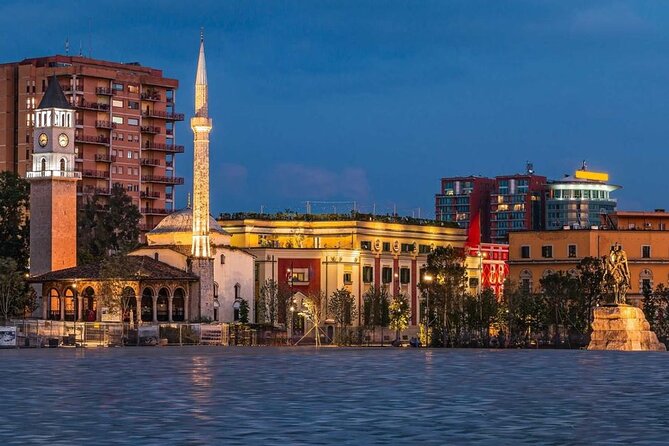
From the square, the route continues along Rruga Murat Toptani toward the Tirana Castle area. Excavations in 2001 and 2008 found traces of walls dating from the period associated with Emperor Justinian, around the fourth to sixth centuries.
Little of the original fortification remains today. That is important to understand before you arrive. You are not walking into a complete medieval castle with towers and intact rooms. Instead, the area offers fragments, later development, and a lively public setting.
The former castle zone now has cafés, restaurants, artisan shops, and galleries. The guide can connect the limited remains with the city’s wider development, while you also get a chance to see how old sites are used in present-day Tirana.
This is one of the more relaxed sections of the tour. It lasts around 20 minutes and provides a change from formal monuments. If you want a major archaeological site, you may find this stop modest. If you enjoy seeing how a city turns old foundations into an everyday meeting place, it earns its place on the route.
The Tanners’ Bridge and a quieter piece of Ottoman Tirana
The Tanners’ Bridge, or Ura e Tabakëve, is an 18th-century Ottoman stone footbridge near the Albanian Parliament. It once carried farmers bringing produce and livestock from the eastern highlands into Tirana.
The name refers to the tabakë, a trade linked with butchering and tanning. The bridge crossed the Lana stream until the river was redirected in the 1930s. After falling into poor condition, it was restored in the 1990s, with its original stones cleaned and an artificial pond added on either side.
The stop lasts about 10 minutes. That is enough to see the bridge and hear its purpose, but not enough for a long historical talk. You should treat it as a small, atmospheric pause rather than a major sight.
I like the bridge because it gives you a glimpse of working Tirana. Grand squares and political buildings tell one story. This simple crossing shows how people once moved food, animals, and goods into the city. It also helps explain that Tirana was once much smaller and more rural around its edges.
The National Gallery of Art and the Cloud installation
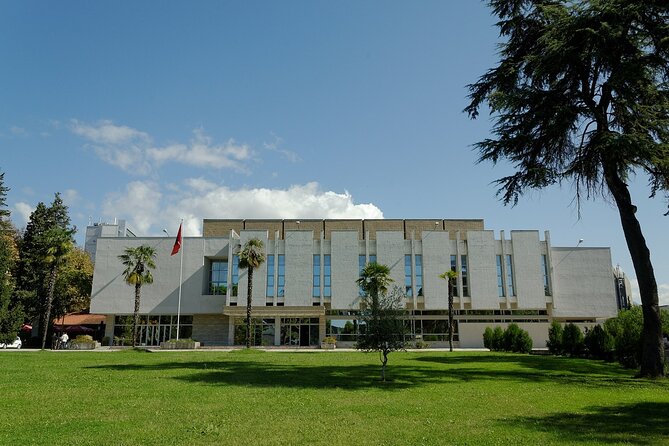
The Albanian National Gallery of Arts was founded in 1954 and is known for its collection of Social Realist art. At the time of this experience, the gallery is closed for expansion, so the stop is mainly an exterior look.
That means you should not book this walk expecting an indoor art visit. The guide can still explain the gallery’s role and point out Communist-era statues of figures such as Stalin and Lenin in the surrounding area. Those remnants are especially useful for understanding how public art was used during Eastern Europe’s Communist period.
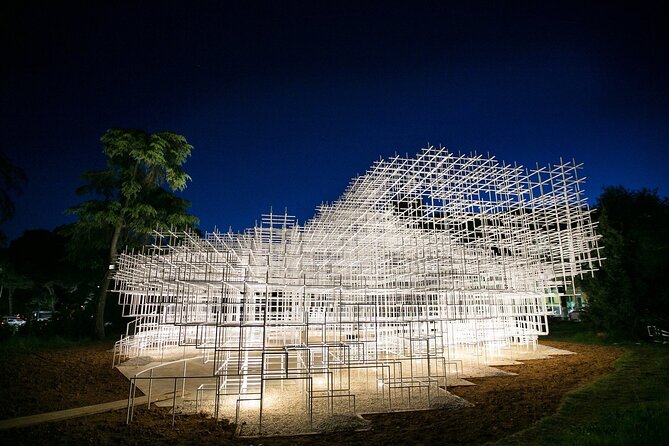
Across from the gallery is REJA, known as The Cloud, designed by Japanese architect Sou Fujimoto. Its open white structure is used for film screenings, performance events, and concerts. It feels very different from the nearby statues and gallery building, which makes this a neat example of Tirana’s current cultural direction.
The stop is only about 10 minutes, and admission is not included. Since the gallery is closed, the value comes from the guide’s explanation and the contrast between old political symbols and new public art.
Blloku, from party privilege to café culture
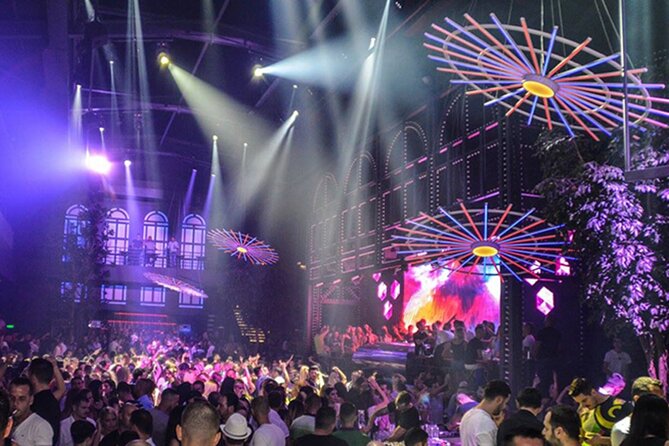
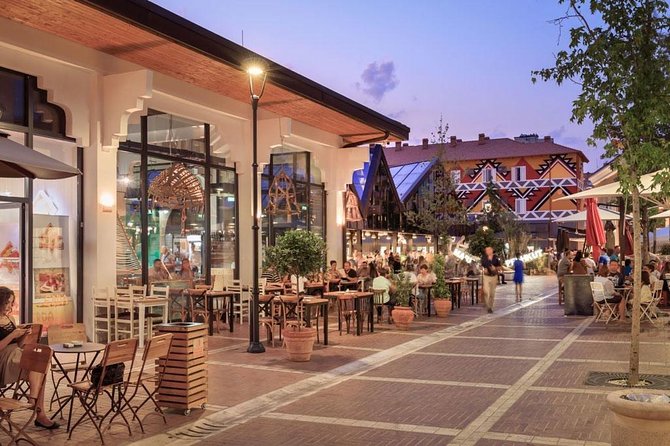
Blloku is the final major neighborhood on the route, and it offers the clearest look at modern Tirana. Today, the area is packed with cafés, bars, restaurants, boutiques, and upscale residences. It is where the city’s social life feels most polished.
During Communist rule, Blloku was closed to ordinary residents. It was reserved for party officials and the ruling elite, with Enver Hoxha’s modest modern villa at its center. The contrast between that restricted past and the area’s current nightlife is hard to miss.
The tour also points out the office of the Albanian president, another important building in the district. The guide explains how Blloku changed after the end of Communism and why it remains such a strong symbol of Albania’s social shift.
The stop lasts about 15 minutes, but you may want to return later on your own. The tour gives you the background. An evening visit lets you see the cafés and bars when the neighborhood is at its most active. Food and drinks are not included, so plan separately if you want to stay for a meal.
What the guides add to the walk
The quality of this experience depends heavily on the guide. Gloria has been praised for taking a broad route through Tirana, explaining both the city’s history and its present-day changes. Ilir has also been praised for speaking excellent English, tailoring the route to personal interests, and making Albanian history entertaining.
That matters because the buildings alone do not explain Tirana. The Clock Tower is attractive, but the guide tells you why it mattered. Blloku is fashionable, but the guide adds the story of who was once allowed to live there. The mosque is beautiful, but the guide explains how it survived the Cultural Revolution.
A particularly useful feature is flexibility. One small group received more individual attention because only three people joined. On another occasion, the National Historical Museum was unexpectedly closed, and the guide arranged cake and tea at a nearby café instead. You should not assume that substitute activity is guaranteed, but the example shows why a flexible guide can make a difference.
On a hot day, you may also appreciate a short drink break. One guide even paid for a local Korça beer for a participant, though you should not treat that as part of the price or a promised inclusion.
Price, pace, and practical value
At $42.10 per person, this is not the cheapest way to walk around Tirana, since many of the sights can be seen from public streets. The value comes from the English-speaking guide, the historical interpretation, and the included Clock Tower and National Historical Museum admission.
The 3 to 4 hour length is useful for a first morning in the capital. You cover the central sights without giving up an entire day. Starting at 9:30 am also leaves time afterward for lunch, independent museum visits, or a return to Blloku.
The route is entirely on foot. Wear comfortable shoes and bring water, especially in warm weather. Food, drinks, tips, hotel pickup, and drop-off are not included. The tour begins and ends at the Tirana International Hotel, Sheshi Skënderbej 8.
Most people can participate, and service animals are allowed. Public transportation is nearby. The experience depends on good weather, so poor conditions can lead to a different date or a full refund. Free cancellation is available up to 24 hours before the start time.
Who should book this Tirana walking tour
I would choose this tour for a first visit, especially if you want a clear introduction before exploring Tirana alone. It suits you if you enjoy history, urban change, religious buildings, and local political context more than a long stop at a single museum.
It is also a good fit for anyone with only a short stay. In one morning, you see the central square, an Ottoman tower and mosque, remnants of the old city, an 18th-century bridge, Communist-era symbols, and Blloku’s modern social scene.
You may want another plan if you dislike walking, stairs, outdoor sightseeing, or short visits. The National Gallery of Art is closed for expansion, and the Tanners’ Bridge and castle area are modest sights. This is a city orientation walk, not a full museum program.
Should you book it?
Yes, if you want Tirana’s major themes explained by a real guide rather than pieced together from plaques. The strongest reasons are the included museum and Clock Tower visits, the small maximum group, and the chance to hear guides such as Gloria or Ilir explain both Albania’s past and its present.
I would book it near the start of your stay. You will learn where the important districts are, understand why Blloku matters, and get practical ideas for later meals and evening walks. Just bring good shoes, allow for changing museum access, and remember that the tour’s real strength is interpretation, not grand ruins.
FAQ
Where does the Tirana walking tour begin?
It begins at the Tirana International Hotel, Sheshi Skënderbej 8, Tiranë 1001, Albania.
What time does the tour start?
The tour starts at 9:30 am.
How long does the experience last?
It lasts approximately 3 to 4 hours.
Is admission to the National Historical Museum included?
Yes. The experience includes a ticket for the National Historical Museum. The museum’s opening status can change, and a closure may require an alternative arrangement.
Is the Clock Tower ticket included?
Yes. Admission to the Clock Tower is included. Reaching the top requires climbing 90 steps.
How large is the group?
The tour has a maximum of 15 participants.
Is hotel pickup included?
No. Hotel pickup and drop-off are not included. The tour begins and ends at the Tirana International Hotel.
What happens if the weather is poor?
The experience requires good weather. If it is canceled because of poor conditions, you will be offered another date or a full refund.
Just added in Tirana
- Wine Tasting day in Berat (Visit to the Berat Castle & Lunch included)★ 4.5 · 6 reviews
- From Tirana Wine Tasting & Food tour in Berat★ 5.0 · 5 reviews
- Berat Cooking Class- Traditional Albanian Cooking Class★ 5.0 · 9 reviews
- UNESCO heritage in Albania – 4 days★ 5.0 · 3 reviews
- Wine Tasting & Vineyards Escape near Tirana★ 5.0 · 18 reviews
- Shen Gjergji Waterfall & Tirana Sunset Included Dinner★ 5.0 · 9 reviews
- Visit Vlore & Himare Beaches includes lunch★ 4.5 · 13 reviews
- 2-Day Private Ohrid Tour in Skopje, Prishtine Trip and Prizren★ 5.0 · 8 reviews
Walking Tours, compared.

Tirana Walking Tour: History, Culture &Gems by a Passionate Guide
Read our review →
Premium Walking Tour of Berat with Expert Guides
Read our review →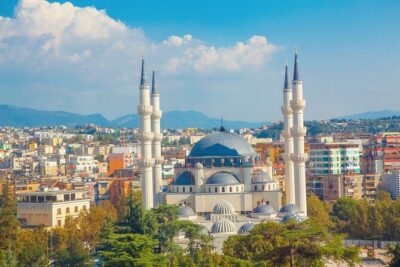
Private Walking Tour Visit to Durrës with Licensed Guide
Read our review →
Walking Tour Baazar – The Argjiro Castle – Zekate house
Read our review →Browse the lists this tour appears in